Media Release
London UK | 3rd September 2025
‘Hybrid Working in the Contact Centre’ survey gives unique insight into homeworking trends 2016 – 2025
The recently announced results of the 2025 ‘Hybrid Working in the Contact Centre’ market survey proved that hybrid working is here to stay but that UK organisations are still struggling with workplace culture.
65% of businesses said that they expect three-quarters or more of their employees to be homeworking (at least part of the time) by the end of 2027, with more employees than ever self-selecting what days they work in the office, and even their workday schedules.
A detailed breakdown of 2025 survey results can be found here (no need to register).
The 2025 survey is the latest in the ‘Hybrid Working in the Contact Centre’ series which has surveyed 100 UK customer contact centre Directors and Managers about their opinions and home and hybrid working experiences every 3 years since 2016. The study is created and managed by Pitch Market Surveys.
Here is a selection of key trends from the ‘Hybrid Working in the Contact Centre’ series from 2016 to 2025.
1. Hybrid Models
The most popular homeworking model continues to be one where people work flexibly between the home and the office (i.e. not consistent days each week) and where EMPLOYEES decide where they work on any given day. This figure has risen from 33% of people surveyed in 2021* to 37% in 2022, and 39% in 2025.
The ‘set days at home and set days in the office’ model has also risen in popularity, from 20% of people surveyed in 2021 to 28% in 2025; with these figures including ‘anchor days’. Of those organisations that embrace homeworking, just 6% in 2025 employ a model where people either work 100% in the office or 100% at home.
2.Return to the Office
In 2025, 71% of respondents stated that three-quarters or more of their contact centre advisers currently work full or part time from home. By the end of 2027, the corresponding figure is predicted to be 65%. While that shows that contact centre professionals expect a slow but significant return to the office over the next 2-3 years that movement is perhaps not as great as some industry analysts have recently predicted.
3. Organisational Hybrid Working Issues
The main hybrid working issues mentioned in 2025 were workplace culture (cited by 62% of respondents), pastoral care (52%), communicating effectively (47%), and managing remotely (40%). Although workplace culture was an option only included in our 2025 survey, pastoral care and effective communications were also the top ranked of the issues in our 2022 survey.
4. Organisational Hybrid Working Benefits
The main hybrid working benefits mentioned in 2025 were happier and more productive employees (cited by 76% of respondents), a lower carbon footprint (56%), reduced attrition/absenteeism (53%), additional business continuity (49%), lower operating costs (48%), and scheduling flexibility (44%). Happier and more productive employees has been the most consistently cited ‘main benefit’ in every ‘Hybrid Working in the Contact Centre’ survey since 2016.
5. Training Hybrid Working Managers
Organisations are providing more specialist training and advice to Managers to support their homeworking teams. In response to the question “does your organisation provide its Managers and Supervisors with sufficient training and advice to enable them to manage, train and support work-from-home and hybrid teams?” 48% of respondents said yes in 2022, compared to 59% in 2025.
6. Enabling Flexible Working
84% of contact centre professionals in 2025 agreed with the statement “my organisation gives its employees the opportunity to work flexibly so they can enjoy a better work-life balance”. Only 5% disagreed.
A frequently mentioned benefit of homeworking is the ability to more easily schedule family and leisure activities around workday schedules. In this regard, it is notable that a growing number of respondents said that their organisations enabled contact centre employees to self-select their own schedules, either fully or partially. 29% of respondents said this was the case in 2022, compared to 44% in 2025.
* The 2021 figure is from an online poll of 208 contact centre professionals conducted by Call Centre Helper
View the 2025 Hybrid Working in the Contact Centre?’ Market Survey eBook (no need to register)
Ends
About Pitch Market Surveys
Pitch Market Surveys (PMS) is the research and analytics arm of Pitch Marketing Communications, a marketing consultancy business. PMS has created and managed each survey within the Hybrid Working in the Contact Centre series (2016, 2019, 2022 and 2025).
For further information contact:
Michael Gray
tel: +44 (0)7785 705587
e-mail: michael.gray@pitch-mc.com
Fig 1: Hybrid Working Models, 2021 – 2025
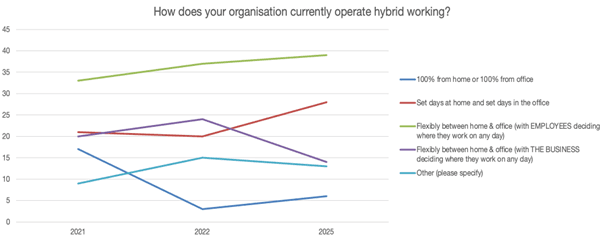
Source: 2025 and 2022 data from Hybrid Working in the Contact Centre survey series (100 respondents); 2021 data from Call Center Helper poll (213 participants)
Fig 2: The Hybrid Working in the Contact Centre series, 2016 – 2025